Designed to get the SAR rescuer back safely as well as the survivor, these kits and items are selected for the team members to kit and ensure their own preparedness on a mission. If your team needs specific requirements met, contact us for details on how we can provide your team with your precise requirements.
Ranger Pace Counter: The time-tested way to keep track of distance you’ve traveled in difficult terrain or conditions. Military personnel have used such simple devices for decades as an easy way to keep track of distance traveled during terrain navigation. This becomes essential during night time movement. The beads work by separating them according to a reached pace count to calculate the distance you’ve traveled. (It’s not as hard as it sounds).
1. Place the beads on an easily reachable but secure place on your equipment, such as a shoulder strap.
2. Find your pace count(s): The average used is 65 paces on flat terrain for 100 meters. However, you will want to know your own pace count. A “pace” is counted by every time your left foot strikes the ground while walking at a reasonable stride. (Yes, you can use your right foot if you prefer).
Measure out 100 meters on flat terrain.
Walk this distance counting your paces (again, every time your left foot strikes the ground).
The number you reach at the end of 100 meters is your pace count for 100 meters of flat terrain.
It is suggested that you get your pace count in several ways: 1) flat terrain, lightly equipped; 2) flat terrain, heavy equipped; 3) medium-steep terrain, lightly equipped, and; 4) medium-steep terrain, heavy equipped. Thus, 4 pace counts are made under these conditions. (Very steep terrain tends not to work well with pace counting). Remember your pace count for each.
As you age or your physical condition changes, your pace count will likely change as well.
3. Using the Pace Counter:
Pull all of the beads in the up position.
The bottom half of the pace counter has 9 beads. Each of these 9 beads represents 100 meters.
When your pace count for the terrain you are on reaches the mark for 100 meters, draw down one bead from the bottom half of the pace counter.
When all 9 beads are down, you have traveled 900 meters.
The top half of the pace counter has 4 beads. Each of these beads represents 1,000 meters (1 kilometer).
Thus, after you have traveled 900 meters, and all of the bottom 9 beads are down, the next 100 meters traveled will be 1,000 meters of travel (1 kilometer). When that mark is reached, you pull one of the top beads down to mark the 1 kilometer of distance traveled, and pull the bottom 9 beads back to their up position.
Continue to do this process until all 4 top beads are down, representing 4 kilometers of travel, and repeat the process by moving all of the beads back to their up position.
Now, the only number you need to keep in your head is the total kilometers traveled after the sequence is complete (4k, 8k, etc.)
NOTE: Some use the technique whereby the down and up position of the beads is used to determine whether you are on the first set (4k) or second set (8k) — and variations of this. Whatever the method you choose, the beads will enable you to keep very few numbers in your head while you continue to travel, while maintaining an accurate pace count related to distance traveled.
ALSO NOTE: This method is best used in conjunction with a topographical map. If your map is in “standard” or English / Imperial measurement (feet/miles, etc.) then be sure to know the conversion between metric and English, or, perform your pace count measurements in the format best used in conjunction with your maps.
FINAL NOTE: This method works best on direct azimuth traveling (straight line distances). If changing direction, it is best to mark the position on your map where you change direction in order to not only measure the distance traveled, but where you are precisely in relation to your map. It will not help you much to perform pace counts while traveling in variable directions without notating the changes on your map.
The Fisher Trekker Tactical Space Pen is the ultimate writing tool to include in survival and emergency kits, simply because it will not fail, and has a robust history of not failing! The ultimate in dependability. Every Space Pen is guaranteed to perform in temperatures from -30 to 250 degrees F, underwater, in zero gravity, at any angle even upside down and over grease. It’s reliability means it’s the only pen you’ll ever need. Matte Black Keychain Pen with Fisher Rubber Comfort Grip. Comes with Carabiner and lanyard.
FEATURES:
Non reflective finish
Pressurized ink cartridge enables writing upside down, at any angle, even over grease, and in extreme temperatures from -30° to 250°F.
The Pro-Knot Waterproof Reference Cards: For anyone who ventures outdoors, the proper knot can make a mountain of difference. From tying down shelters and loads, fishing, and so many other tasks. Without the right knot, you risk losing your gear, or even your life in some situations. Make sure YOU know how to tie the proper knot with these water proof, durable, credit card sized, double-sided reference cards. They come attached with a brass grommet and can swivel outward so that the deck always stays together no matter what you are doing.
20 of the most useful knots are clearly demonstrated for anyone to learn and tie the proper knot:
Bowline
Tautline Hitch
Square Knot
Water Knot
Buntline Hitch
Bowline on a Bight
Mooring Hitch
Butterfly Knot
Figure Eight
Truckers Hitch
Double Fishermans
Sheet Bend
Prusik Knot
Constrictor Knot
Clove Hitch
Half Hitch
Rolling Hitch
Cleat Hitch
Timber Hitch
Sheepshank
Memory can fail: Pro-knot cards do not! Take these with you, put them in your survival kits and emergency preparation kits, vehicles, or even sew them into coats and jackets!
Like no other NIOSH 95 Certified Respirator You Have Ever Seen.
The NAR Respirator provides front-line protection for First Responders with an advanced particulate barrier. Low breathing resistance for increased wearer comfort. Foldable design and sealed edge avoids open layers and eliminates the possibility of Irritation. Latex-free synthetic rubber head straps, adjustable nose clip and soft foam nosepiece for comfortable custom fit. Exhalation valve reduces hot air buildup and makes it easier to breathe in hot/humid environments.
Special Features:
Certified to the NIOSH N95 standard for disposable particulate respirators
Carbon layer for relief against nuisance levels of organic vapors
Secure, comfortable fit with adjustable nose bridge
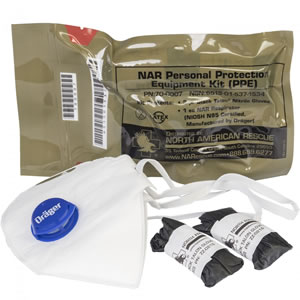
The PPE (Personal Protection Equipment) Kit is the essential personal protection for anyone who is responsible for indigenous healthcare, detainee processing or disaster response where various hazards and contaminants may be encountered. Our kit features the state of the art NAR Respirator and Black Talon Ultimate Nitrile Gloves in a compact lightweight kit. The NAR PPE Kit is supplied in a vacuum sealed, rugged, easy-to-open package that allows for quick and effective application in the most extreme conditions.
Special Features:
Certified to the NIOSH N95 standard for disposable particulate respirators
Carbon layer for relief against nuisance levels of organic vapors
Secure, comfortable fit with adjustable nose bridge and low breathing resistance
Reduced packaging volume for easy storage
Supplied with two individually wrapped pairs of Black Talon Nitrile Gloves (Size: Large)
SAM Technology – Now in a Tactical Subdued Color and made to meet military requirements: The malleable SAM Splint II is versatile; it can be easily molded to fit almost any fracture. It is also lightweight for easy transport, strong for reliable support and expertly designed for patient comfort. Waterproof and impervious to environmental extremes, its durable design performs equally well under any conditions. The practical SAM Splint II is also easy-to-clean, reusable and compact so it minimizes storage and maximizes usefulness.
Special Features:
Specifically designed to meet military requirements
The SAM SPLINT is built from a thin core of aluminum alloy, sandwiched between two layers of closed-cell foam. Freshly unrolled from storage, the splint is extremely pliable. Bent into any of three simple curves, it becomes extremely strong and supportive for any fractured or injured limb.


 Designed to get the SAR rescuer back safely as well as the survivor, these kits and items are selected for the team members to kit and ensure their own preparedness on a mission. If your team needs specific requirements met, contact us for details on how we can provide your team with your precise requirements.