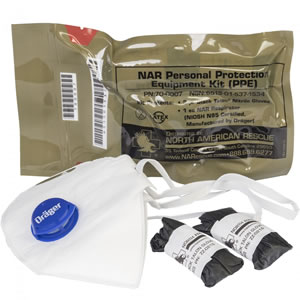

 Personal Protective Equipment, known as “PPE”, are your tools to protect you and the patient from contamination. Respirators and nitrile gloves are primary defense tools for this effort, but also serve additional purposes outside medical treatment. Respirators such as R95 and N95 masks limit particulate inhalation from a variety of sources, and nitrile gloves permit a barrier between you and whatever may be a source of contamination (think: skinning rabbits). Also included in this category are more specific protective measures: like the Breath of Life Escape Mask and Fast-Act® chemical decontamination tools.

Breath of Life Emergency Escape Mask
Sold Out
The Breath of Life Emergency Escape Mask (Newly Improved Packaging!) provides the wearer 15 to 20 minutes to escape from an attack scene or a burning building with the ability to breathe without inhaling smoke or fumes. Available for personal and commercial use in the U.S. for the first time, the pocket sized Breath of Life mask weighs less than one and a half ounces and can be carried in a briefcase or pocketbook.
The Breath of Life Emergency Escape Mask:
- Empowers escape from danger to safety when threatened by smoke, dust, terrorist attack or natural disaster (wildfires, tornados and earthquakes)
- Provides real protection from hazardous airborne particulate matter, including smoke, dust, biological toxins and chemical agents
- Is lightweight, highly portable and easily accessible in case of emergency
- Fits easily over the head, including beards or glasses, and closes tightly around the neck, protecting the head, face and eyes. One size fits all.
- Can save lives in case of an emergency by providing the vital time needed to escape.
- Vacuum-packed and portable, the Breath of Life Emergency Escape Mask fits into a pocket or purse, for easy accessibility in an emergency.
- The Breath of Life mask protects eyes, nose, ears, mouth and face by preventing the penetration of unfiltered air. Inhaled air enters only via the mask filters. Breathing is easy via the masks filters and a precision one-way exhalation valve.
- activated charcoal are used as purifying and decolorizing agents, for the removal of residual gases in low pressure apparatus, and in respirators as a protection against toxic gases.
- With airflow of 10 cub. ft. per minute for 15 minutes containing 16.0 gr. of dust, out of which 14.6 gr. (91.25%) were absorbed by the charcoal layer.
The Technon Breath of Life Mask embodies The Science of Survival:
FEATURES:
The Breath of Life filter is effective against:
Particles, acids, alkalis, gases, microorganisms and mustard gas. Smoke and aerosols containing suspected harmful microorganisms including Escherichia coli, Salmonella enteritidis, Serratia marcescens, Proteus mirabilis, Pseudomonas fluorescens, Staphylococcus cohnii, Staphylococcus aureus, Streptococcus pyogenes, Enterococcus hirae, Bacillus subtilis, Bacillus clausii, Bacillus stearothermophilus. The effectiveness of the filter against microorganisms has been tested by the Department of Biology at the University of Ferrara in Italy. Twelve different microorganisms were tested showing effective results of filtering properties between 94.5% and 100%.
SPECIFICATIONS:
Hood
The hood of the Breath of Life mask is made from transparent 5-layered laminate and is resistant to penetration of particles, acids, alkalis, gases & microorganisms.
Filter
The filter is composed of four different layers.
First and Fourth Layers
Made from viscose strengthened by polyester fibers 150 gr/sq. m. Contains 0.3% Cetylpyridinium Chloride (CPC) as an antiseptic that neutralizes bacteria that may enter through the filter. The first layer acts as a pre-filter against large particles.
Second Layer
A second layer filters particles of 0.3 microns or more, tested for air permeability by the Frazier Air Permeability Method, – 55cfm/sf at 0.5 in. water Gauge.
Third Layer
A third layer is made of Polyester non-woven material, thickness: 1.2 mm, containing active charcoal in a concentration of 114 gr. out of a total of 200 gr. Sq/m. – 57% intended to reject air pollution and gas flow, both in dynamic or static conditions. Active charcoal is described as follows in professional literature:
Tests were conducted on this layer conforming to Standard SAE J 726 / ISO 12103/A Coarse Grade Test Dust, with the following results:
Note: Characteristics not mentioned as tested and proven, should not be attributed to the filter.
Breath of Life Emergency Escape Mask Technical Data
Breath of Life Emergency Escape Mask FAQ
Fits in your pocket, your purse, your glove compartment — nearly anywhere. Can you afford not to have 15-20 minutes of escape!